Not long ago, ranking #1 on Google was the holy grail of digital marketing. Businesses poured budgets into backlinks, keyword density, and meta tags — all to earn a coveted spot among ten blue links.
Then came AI.
Today, when someone types a question into ChatGPT, Perplexity, or Google’s AI Mode, they don’t get ten links to scroll through. They get a single, synthesized answer — drawn from multiple sources, written in plain language, and delivered in seconds. And buried inside that answer are a handful of citations.
Your brand is either one of them — or it isn’t.
This is the new battlefield of digital visibility. And the discipline that determines who wins it is called Generative Engine Optimization, or GEO.
If you’ve been hearing the term but aren’t sure exactly what it means, how it differs from traditional SEO, or how to actually implement it — this guide is for you.
What Is Generative Engine Optimization (GEO)?
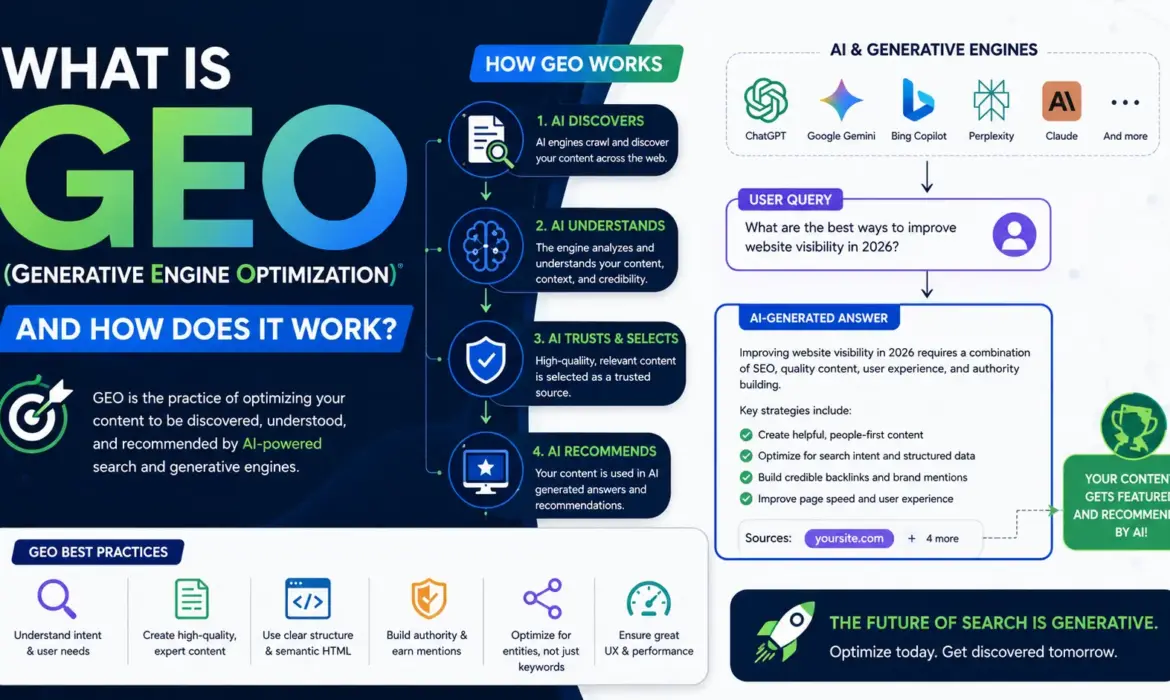
Generative Engine Optimization (GEO) is the practice of structuring, writing, and publishing content so that AI-powered search engines — ChatGPT, Perplexity, Google AI Overviews, Gemini, Microsoft Copilot, and Claude — cite your brand when generating answers to user queries.
Where traditional SEO earned you a ranked position on a results page, GEO earns you a citation inside an AI-generated answer. The distinction matters enormously:
- SEO gets you clicked. Users see your link and decide whether to visit.
- GEO gets you quoted. AI reads your content, trusts it, and references it — often without the user ever visiting your site.
Think of GEO as the difference between being listed in a directory and being recommended by a trusted advisor. The AI becomes that advisor. Your job is to become the source it trusts.
“GEO is not a replacement for SEO — it is an additional layer. Brands that excel at GEO in 2026 are typically the same brands with strong traditional SEO foundations.” — Enrich Labs, GEO Guide 2026
Why GEO Matters Right Now (The Numbers Tell the Story)
This isn’t a future trend to prepare for. It’s a present-day reality to act on.
- ChatGPT now has 800+ million weekly active users — more than the population of Europe.
- Gartner projects traditional search engine volume will decline 25% by 2026, with AI chatbots capturing that share — and a 50% reduction in traditional organic search traffic projected by 2028.
- 58.5% of Google searches in the US already end without a click. When AI Overviews appear, organic click-through rates drop by 61%.
- Early GEO adopters report that 32% of their sales-qualified leads now come from generative AI search — compared to virtually none just months ago.
- AI-driven traffic converts at significantly higher rates than traditional search, with some studies showing 5× higher conversion rates.
The window to act is open. Fewer than 12% of marketing teams have a documented GEO strategy. The brands that build citation authority now will own the AI search results of 2027, 2028, and beyond — because citation authority, like domain authority before it, compounds over time.
GEO vs. SEO vs. AEO: Understanding the Difference
These three acronyms live in the same neighbourhood but serve different functions:
| SEO | AEO | GEO | |
| Full Name | Search Engine Optimization | Answer Engine Optimization | Generative Engine Optimization |
| Primary Goal | Rank in Google’s blue links | Win featured snippets & voice answers | Be cited in AI-generated responses |
| Optimizes For | Crawlers & ranking algorithms | Structured Q&A, voice search | LLMs, RAG systems, AI synthesis |
| Success Metric | Rankings, organic traffic | Featured snippet wins | AI citation frequency |
| Content Style | Keyword-rich, long-form | Direct, question-answer format | Structured, data-rich, entity-clear |
In 2026, these three work best as a combined strategy. SEO builds your discoverability foundation. AEO captures intent-rich, zero-click moments. GEO ensures that when AI systems are synthesizing answers for your audience, your brand is part of the conversation.
How Do AI Search Engines Actually Work?
Before you can optimize for AI engines, you need to understand how they select content. The key technology is called Retrieval-Augmented Generation (RAG).
Here’s the simplified version:
- A user asks a question — for example, “What’s the best digital marketing strategy for a small business?”
- The AI retrieves relevant content from the web (for open-world engines like Perplexity and Google AI Overviews) or from its training data (for closed-world models).
- The AI synthesizes a response by pulling together information from multiple sources.
- It cites the most authoritative, clear, and structured sources — these become the citations users see.
The critical insight: AI engines don’t rank pages. They evaluate pages for citation-worthiness. A page that answers a question directly, uses original data, has a clear author, and is structured for machine readability is far more likely to be cited than one that buries its answer under vague introductions.
Google’s own official guidance (published May 2026) confirmed this: “AI Overviews and AI Mode are rooted in the same core ranking and quality systems as regular Search — but with additional requirements around content structure and query fan-out.” This means your GEO strategy must cover multiple related questions within each piece of content, not just a single keyword.
The 5 Core Signals That Drive AI Citations
The foundational GEO research — a peer-reviewed study from Princeton University, Georgia Tech, the Allen Institute for AI, and IIT Delhi (published at ACM SIGKDD 2024) — tested optimization strategies across 10,000 queries and measured exactly which tactics improved AI visibility:
1. Statistics and Original Data (+32% visibility lift)
AI engines strongly prefer content that contains verifiable numbers and proprietary data. A sentence like “email marketing has a 42:1 ROI” is far more citation-worthy than “email marketing performs well.” Whenever possible, reference your own client results, case studies, or original research — this is content no AI-generated competitor can replicate.
2. Quotations and Expert Citations (+41% visibility lift)
Including quotes from named experts, industry reports, or authoritative institutions signals to AI that your content has been corroborated. This includes quoting clients (with permission), researchers, or recognized authorities in your field.
3. Direct, Clear Answers in the First 200 Words (+28% from fluency optimization)
AI systems that use real-time retrieval evaluate a page’s relevance primarily on its opening content. The first 200 words of any article should directly and completely answer the primary query — not build up to it over three paragraphs of preamble. This is sometimes called the TLDR-first approach: answer first, elaborate second.
4. Structured Content and Schema Markup
Clean heading hierarchies (H1 → H2 → H3), FAQ sections with schema markup, comparison tables, and numbered lists all help AI systems extract and synthesize your content efficiently. Pages that AI can parse easily are far more likely to be cited than pages with unstructured prose.
5. Third-Party Citations and Brand Mentions (+30% from citation signals)
AI engines apply multi-source corroboration: if your brand is mentioned positively across multiple independent domains — trade publications, review sites, news outlets, forums — the AI assigns higher confidence that your brand is an authoritative entity. This means digital PR, community participation (Reddit, LinkedIn, industry forums), and earned media directly feed your GEO performance.
7 GEO Tactics You Can Implement Today
Tactic 1: Restructure Your Content for Direct Answers
Audit your most important blog posts and service pages. Rewrite introductions so the key answer appears in the first paragraph. Think of every page as a potential AI-cited source: what is the one clear thing you want AI to extract from this page?
Tactic 2: Build Topic Clusters, Not Just Individual Pages
Google’s AI systems use “query fan-out” — breaking a single question into multiple related searches before synthesizing an answer. This means a page about “local SEO” that also answers “how to rank in Google Maps,” “what is local schema markup,” and “how to optimize Google Business Profile” will be cited across a broader range of queries than a page answering only one of those.
Build pillar pages with deep subtopic coverage, linked to dedicated cluster pages on each subtopic.
Tactic 3: Publish Original Research and Data
Proprietary data is citation gold. Original case studies, benchmarks from your own client work, surveys of your target audience — these create content that AI systems have a unique reason to cite. Every competitor can write about “the importance of page speed.” Only you can publish “We audited 50 SMB websites and found that 73% failed INP benchmarks.”
Tactic 4: Add llms.txt to Your Website
A new convention emerging in 2025–2026, the llms.txt file tells AI crawlers what your website does, what pages matter, and how to interpret your content. It is the robots.txt equivalent for the AI search era. If your web developer hasn’t implemented this yet, it’s a quick technical win that most of your competitors haven’t taken yet.
Tactic 5: Build Your Author’s Entity Authority
AI systems evaluate the credibility of who wrote content, not just the content itself. Ensure every blog post has a named author with a bio that includes credentials, links to their LinkedIn, and ideally a Google Knowledge Panel entity. The E-E-A-T (Experience, Expertise, Authoritativeness, Trustworthiness) signals that Google has long valued are now directly linked to GEO citation likelihood.
Tactic 6: Earn Third-Party Mentions Systematically
Submit expert commentary to industry publications. Participate in forums relevant to your niche. Issue press releases on notable milestones. Get listed on relevant directories and review platforms. The goal is consistent, positive brand mentions across multiple independent domains — the same signal that tells AI engines your brand is credible enough to cite.
Tactic 7: Update Your Content Regularly
AI engines weigh recency when selecting sources. A guide published in 2023 with no updates will lose ground to a 2026 article on the same topic. Add a visible “Last updated” timestamp to all cornerstone content, refresh statistics quarterly, and add a “What’s changed in [year]” section to keep AI engines returning to your page as the freshest source.
Platform-Specific GEO: Not All AI Engines Are the Same
Different AI platforms use different retrieval mechanisms, which means your approach should be slightly tailored:
Google AI Overviews / AI Mode: Still rooted in Google’s core ranking systems. Strong traditional SEO (backlinks, technical health, E-E-A-T) is the foundation. Schema markup, FAQ sections, and structured data directly improve AI Overview inclusion.
Perplexity: A real-time web retrieval engine. Freshness and backlink authority matter enormously. Pages that load fast, have clean architecture, and are cited on high-authority third-party sources are most likely to appear.
ChatGPT (with Browse / Search): Blends training data with real-time retrieval. Brand mentions across the broader web — forums, review sites, news, LinkedIn — feed into how confidently ChatGPT associates your brand with a topic.
Gemini: Google-native, so aligned with Google’s quality signals. Structured data, authorship clarity, and topical depth on your website are the primary levers.
How to Measure GEO Performance
Measurement is the biggest gap in most GEO strategies today. Here’s a practical starting framework:
1. AI Citation Audits (Manual, Weekly) Build a list of 10–15 questions your content definitively answers. Query each question on ChatGPT, Perplexity, and Google AI Mode. Document whether your brand is cited, where in the answer, and with what context. Track week-over-week.
2. GA4 Referral Traffic from AI Platforms In Google Analytics 4, create a segment filtering referral traffic from chat.openai.com, perplexity.ai, gemini.google.com, and similar AI platforms. Monitor volume and — critically — conversion rate compared to organic search.
3. Brand Mention Monitoring Tools like Brand24, Mention, or Talkwalker track brand mentions across the web. While they don’t specifically track AI citations, an increase in web mentions across authoritative domains is a leading indicator of improved AI citation likelihood.
4. Zero-Click Content Performance GEO success often manifests as reduced click-through rates alongside increased branded search volume, direct traffic, and conversion rate. If users are hearing your name in AI answers and then searching directly for you, GA4’s branded query data will reflect this.
GEO Is Not a Replacement for SEO — It’s the Evolution
One of the most important things to understand about GEO is what it isn’t. It is not a reason to abandon your existing SEO investment.
The technical fundamentals overlap significantly: fast-loading, crawlable, well-structured websites with strong E-E-A-T signals are the foundation for both traditional rankings and AI citations. The strongest GEO performers in 2026 are typically the brands with the strongest SEO foundations.
What GEO adds is a specific set of requirements around content structure, citation-friendliness, entity authority, and third-party corroboration that traditional SEO alone doesn’t address.
Think of it this way: SEO built the highway. GEO is about making sure AI-driven vehicles can travel it — and recommend it to every passenger.
Action Plan: Where to Start with GEO
If your business is new to GEO, here’s the 30-day starting point:
Week 1 — Audit Run a citation audit across your top 10 target queries on ChatGPT, Perplexity, and Google AI Mode. Identify which competitors are being cited and why.
Week 2 — Content Structure Rewrite the introductions of your five most important blog posts and service pages to answer the primary query in the first 150 words. Add FAQ sections with schema markup to each.
Week 3 — Technical Foundations Work with your web developer to implement llms.txt, review your schema markup coverage, and ensure your author bios are entity-rich and linked to external profiles.
Week 4 — Brand Mention Campaign Identify three to five relevant industry publications, directories, or forums where your brand should have a presence. Begin a systematic outreach or content placement program.
Then measure, iterate, and compound.
Final Thought: The Citation Window Is Open
The brands that build GEO authority in 2026 will be the brands that AI systems cite in 2027, 2028, and beyond. Citation authority compounds — just as domain authority did in the early days of SEO.
The competitive window is open right now. Most businesses in most industries haven’t started. Early movers earn disproportionate returns.
The question isn’t whether GEO matters for your business. It’s whether you’ll be the brand your industry’s AI answers cite — or the one they overlook.
Ready to build your GEO strategy? Our team combines deep technical web development expertise with data-driven digital marketing to help businesses earn authority in both traditional search and AI-generated answers. Get in touch →