
If you ask ten SEO agencies how long SEO takes, you’ll get ten vague answers. “It depends.” “Every website is different.” “Trust the process.”
All of that is technically true — and none of it helps you make a business decision.
You’re investing real money every month. You deserve a real answer: what should happen, when it should happen, and how to tell the difference between an SEO campaign that’s building momentum and one that’s quietly burning your budget.
So here it is — the honest version, without the hedging.
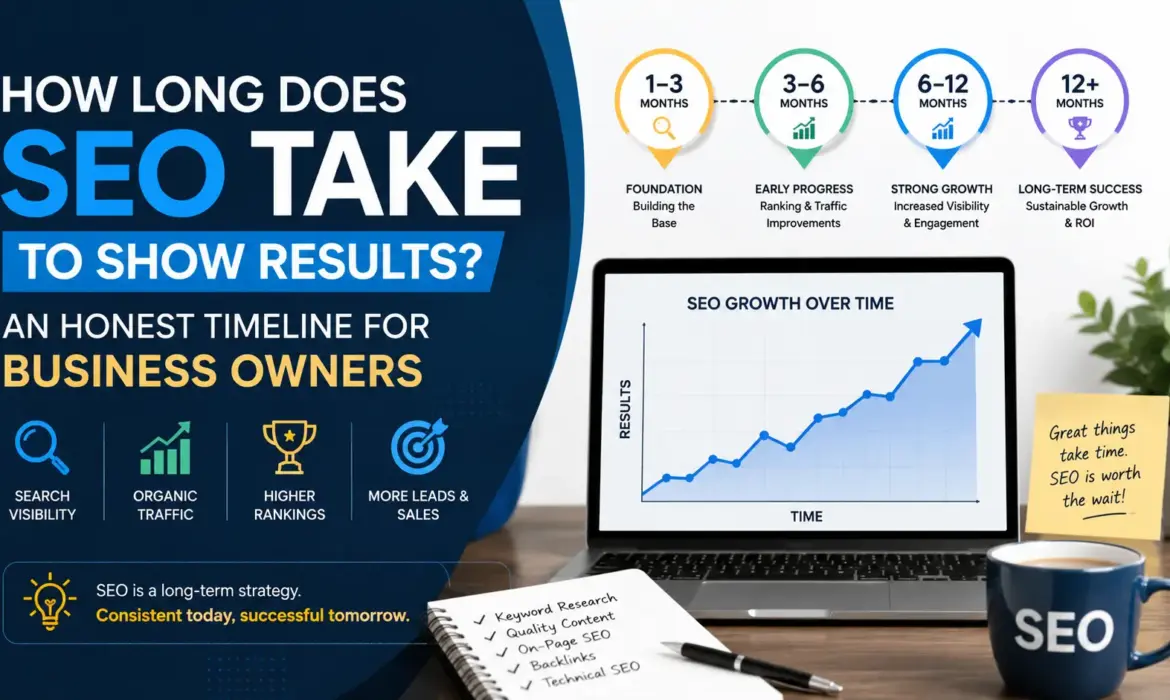
The short answer: Most businesses see early movement in 3–4 months, meaningful traffic growth in 4–6 months, and revenue-level impact in 6–12 months. But the range is wide, and the why behind that range matters more than the numbers themselves.
Let’s break down exactly what happens in each phase, what speeds SEO up, what slows it down, and the warning signs that your campaign is stalled — not just “still ramping up.”
Why SEO Takes Time (The Part Most Agencies Won’t Explain)
SEO isn’t slow because agencies are lazy or Google is mysterious. It’s slow because three separate clocks are running at once:
1. Google’s discovery and trust clock
Before Google ranks a page, it has to crawl it, index it, and decide it’s trustworthy. New pages on established sites can be indexed in days. New domains with no history? Google watches them cautiously for months before granting competitive rankings. This is why a brand-new website almost always takes longer than an established one — regardless of how good the SEO work is.
2. The competition clock
You’re not ranking in a vacuum. For a keyword like “SEO services in California,” you’re competing against businesses that have been publishing content, earning links, and building authority for five or ten years. Closing that gap takes sustained effort, not a one-time optimization.
3. The compounding clock
SEO results don’t grow in a straight line — they compound. One article ranking on page one is nice. Thirty articles ranking, linking to each other, and feeding authority to your service pages is a traffic engine. The early months feel slow because you’re building the base of the curve. The later months feel fast because you’re riding it.
This is also why SEO, done right, keeps paying off after the work slows down — unlike paid ads, which stop the moment you stop feeding the meter.
The Realistic SEO Timeline: Month by Month
Here’s what a well-run SEO campaign typically looks like. Your mileage will vary based on the factors we cover in the next section — but this is the honest baseline.
Months 1–2: Foundation (You’ll see work, not rankings)
What’s happening behind the scenes:
- Full technical SEO audit — crawl errors, indexation problems, site speed, Core Web Vitals, mobile usability
- Keyword research mapped to actual buyer intent, not just search volume
- Competitor analysis to find the gaps you can realistically win
- Fixing technical errors: broken links, duplicate content, missing meta tags, thin pages, redirect chains
- On-page optimization of your most important pages
What you should see: A documented audit, a clear strategy, and a list of what was fixed. Rankings may twitch slightly as Google recrawls your improved pages, but don’t expect traffic changes yet.
Honest expectation: This phase feels invisible. It isn’t. A campaign that skips foundation work is the #1 reason SEO “doesn’t work” later.
Months 3–4: Early Signals
What’s happening:
- New content targeting long-tail, lower-competition keywords starts getting indexed
- Google begins re-evaluating your site based on the technical improvements
- Link building and digital PR efforts start earning your first quality backlinks
What you should see:
- Long-tail keywords entering the top 20–50
- Impressions climbing in Google Search Console (this happens before clicks — it’s the leading indicator most business owners overlook)
- Small but measurable organic traffic increases, often 10–30% over baseline
- For local businesses: improved Google Business Profile visibility and early map-pack movement
Honest expectation: This is where impatience peaks and where bad decisions get made. Impressions rising while clicks lag isn’t failure — it’s Google testing your pages in results before committing to higher positions.
Months 4–6: Visible Growth
What’s happening:
- Earlier content matures and climbs from page two to page one
- Internal linking starts distributing authority to your money pages
- Your backlink profile reaches a threshold where Google trusts you for more competitive terms
What you should see:
- Multiple keywords in the top 10, including some with commercial intent
- Organic traffic growth of 50–100%+ over your starting baseline (varies widely by starting point)
- Your first trackable leads or sales attributed to organic search
- Local businesses: consistent map-pack appearances for core service + city terms
Honest expectation: This is the inflection point. If you’re seeing nothing by month six — no ranking improvements, no impression growth, no long-tail wins — something is wrong with the strategy, the execution, or the website itself. More on that below.
Months 6–12: Compounding Returns
What’s happening:
- Content clusters establish topical authority — Google starts ranking your new content faster because it trusts your site on the subject
- Competitive head terms (the expensive, high-volume keywords) become winnable
- SEO starts outperforming paid channels on cost-per-lead
What you should see:
- Rankings for competitive commercial keywords
- Organic search becoming a top-3 traffic and lead source
- Measurable revenue attribution, not just traffic charts
- New content ranking in weeks instead of months
Year 2 and Beyond: The Moat
This is where SEO becomes unfair. Your accumulated content, links, and authority form a barrier competitors can’t buy their way past quickly. Maintenance costs drop relative to returns, and organic search often becomes the cheapest lead source in your entire marketing mix.
7 Factors That Speed Up (or Slow Down) Your SEO Timeline
Two businesses can run identical campaigns and see results months apart. Here’s what actually moves the needle:
- Website age and history. An established domain with existing authority can see results in 2–3 months. A brand-new domain typically needs 6–12 months to earn Google’s trust. If your site has a history of penalties or spammy links, add time for cleanup.
- Competition level. “Emergency plumber in Fresno” and “personal injury lawyer in Los Angeles” live in different universes. High-value legal, medical, financial, and insurance keywords can take 12–18 months. Local service keywords in mid-size markets often move in 3–6.
- Your starting technical health. A site riddled with crawl errors, slow load times, duplicate content, and indexation problems has to be fixed before it can grow. A technically clean site starts climbing immediately.
- Content velocity and quality. Publishing four genuinely helpful, search-optimized pieces a month builds authority dramatically faster than one generic post a month. Google’s helpful content systems reward depth and expertise — thin content now actively hurts you.
- Backlink profile. Links remain one of Google’s strongest ranking signals. Sites earning quality, relevant links monthly outpace those that don’t — often by a factor of months.
- Local vs. national scope. Local SEO generally shows results faster (3–6 months) because you’re competing in one geographic market. National and e-commerce SEO takes longer because the competitive field is exponentially larger.
- How fast changes get implemented. This one’s on both sides of the table. If technical recommendations sit in a developer queue for three months, your timeline extends by three months. The fastest campaigns are partnerships, not hand-offs.
What “Results” Actually Means (Measure the Right Things at the Right Time)
One of the biggest sources of frustration is measuring month-6 metrics in month 2. Here’s the right scoreboard for each phase:
| Phase | What to measure | What to ignore (for now) |
| Months 1–2 | Technical fixes completed, pages indexed, strategy documented | Traffic, leads, rankings |
| Months 3–4 | Impressions, long-tail rankings, indexed content count | Revenue, head-term rankings |
| Months 4–6 | Organic traffic growth, page-one keywords, first leads | Comparing yourself to 10-year-old competitors |
| Months 6–12 | Leads, conversions, revenue attribution, cost per lead vs. paid ads | Vanity keywords that don’t drive buyers |
If your SEO provider only ever shows you rankings — and never connects the work to traffic, leads, and revenue — that’s a reporting problem, and often a results problem hiding underneath it.
Red Flags: How to Tell “Ramping Up” From “Going Nowhere”
Patience is required in SEO. Blind patience is not. Watch for these warning signs:
- No technical audit in the first month. If they skipped the foundation, everything built on top is unstable.
- Zero movement in impressions by month 4. Even before rankings and clicks, impressions in Search Console should be trending up. Flat impressions at month 4+ means Google isn’t responding to the work — or the work isn’t happening.
- Guaranteed #1 rankings. Nobody can guarantee rankings. Google says so explicitly. Guarantees are a sales tactic, not a strategy.
- Mystery deliverables. If you can’t get a straight answer about what was done last month — which pages were optimized, what content was published, which links were earned — assume the answer is “not much.”
- Rankings for keywords nobody searches. Ranking #1 for your own brand name plus obscure zero-volume phrases isn’t progress. It’s report padding.
- Traffic up, leads flat, no explanation. Sometimes this is a targeting problem (wrong keywords attracting the wrong visitors). A good partner diagnoses it. A bad one hides it in a traffic chart.
A transparent SEO partner shows you what changed, what improved, and what didn’t — in plain language, every month.
“Can I Speed This Up?” — What Actually Works
You can’t skip the timeline, but you can compress it:
- Fix technical debt immediately. Every week a crawl issue or speed problem persists is a week Google discounts everything else you do.
- Target long-tail keywords first. “SEO services” might take a year. “SEO services for dental clinics in Sacramento” might take eight weeks — and the searcher is closer to buying.
- Optimize existing pages before writing new ones. Pages already ranking on page two are your fastest wins. Improving them can move rankings in weeks.
- Publish consistently, not occasionally. Sustained content velocity signals an active, authoritative site.
- Don’t neglect your Google Business Profile (for local businesses). It’s often the fastest lever in local SEO — reviews, categories, photos, and posts can move map-pack visibility within weeks.
- Run paid ads as a bridge, not a substitute. Smart businesses use PPC for immediate leads while SEO compounds in the background — then dial ad spend down as organic takes over the cost-per-lead battle.
What doesn’t work: buying cheap links, mass-producing AI-spun content, keyword stuffing, and anything pitched as a “shortcut.” These tactics don’t just fail — they can trigger penalties that set you back a year or more. The fastest sustainable path is doing the right things sooner, not doing shady things faster.
Conclusion
SEO takes 3–6 months to show real movement and 6–12 months to change your business — and any answer dramatically shorter than that is a red flag, not a bargain.
The businesses that win at SEO aren’t the ones who found a faster timeline. They’re the ones who started sooner, measured the right things at each stage, and worked with a partner who showed them exactly what was happening and why.
Want to know where your website stands right now? Get a free SEO audit from Smacpage Technology. You’ll receive a prioritized list of what’s holding your site back and a realistic, honest roadmap — with timelines tied to your market, not generic promises.
Frequently Asked Questions
How long does SEO take for a brand-new website? Typically 6–12 months for meaningful results. New domains start with zero authority and zero content history, so Google needs more evidence before ranking them competitively. Long-tail and local keywords can move faster — sometimes within 3–4 months.
Why did my traffic drop after starting SEO? Short-term fluctuations are normal when Google recrawls a restructured site, and algorithm updates can cause temporary swings. A sustained drop, however, warrants investigation — ask your provider for a specific diagnosis, not reassurance.
Is SEO worth it if it takes this long? For most businesses, yes — because the economics invert over time. Paid ads cost the same (or more) every month forever. SEO front-loads the cost and then compounds: by year two, organic leads are often the cheapest leads you generate.
Can SEO work in 30 days? Technical fixes and existing-page optimizations can produce small wins in 30 days, especially on established sites. But anyone promising transformative results in a month is selling you something that doesn’t exist.
How much should I expect to invest before seeing ROI? Plan for at least 6 months of investment before judging ROI, and 12 months for a fair verdict in competitive industries. If your budget can’t sustain 6 months, it’s often smarter to start with a narrower scope (local SEO, one service line) than to spread thin and quit early.
Does SEO ever stop working? Rankings require maintenance — competitors keep publishing, and Google keeps updating. But maintaining position costs far less than earning it. SEO is a garden, not a building: it needs tending, not reconstruction.