If you’ve been managing a website for more than a few months, you’ve probably noticed something odd happening to your search traffic. Rankings look fine. Keywords are still tracking well. But the clicks aren’t coming in like they used to.
Here’s why: people aren’t just Googling anymore. They’re asking ChatGPT, Gemini, and Perplexity for answers directly — and getting them without ever visiting a website. That shift is what’s created the conversation around GEO, or Generative Engine Optimization.
So does that mean traditional SEO is dead? Not quite. But it does mean the game has split into two related but different disciplines, and understanding both is the only way to stay visible going forward.
What Traditional SEO Actually Does
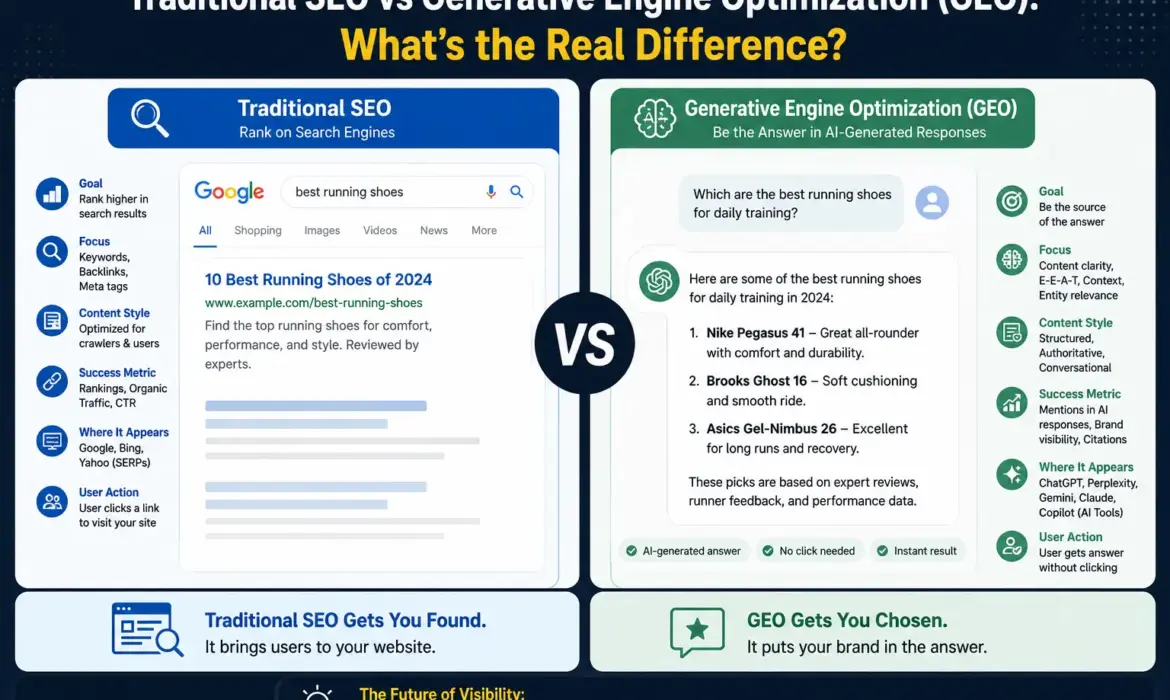
Traditional SEO is built around one goal: getting your page to rank on a search engine results page so a human clicks on it. That means:
- Targeting specific keywords people type into Google
- Building backlinks to signal authority
- Optimizing page speed, mobile experience, and site structure
- Writing meta titles and descriptions that earn the click
The entire model depends on the “ten blue links” experience — you rank, someone sees your listing, they click, they land on your site.
What GEO Is Actually Optimizing For
GEO isn’t about ranking on a results page. It’s about being the source an AI model pulls from — and ideally names — when it answers a question. Instead of a click, the win is a mention.
That changes the rules quite a bit. AI models don’t care about meta descriptions. They care about:
- Clear, factual, well-structured content they can extract and summarize
- Being referenced in comparison articles, forums, and third-party reviews (Reddit and Quora carry surprising weight here)
- Consistent, accurate information about your brand across the web
- Structured data and schema that make your content machine-readable
- Original data, research, or case studies that make your content citable
In short, traditional SEO optimizes for human clicking. GEO optimizes for a machine trusting you enough to repeat what you said.
Where the Two Actually Overlap
This is the part most people miss: GEO isn’t a replacement for SEO — it’s built on top of it. AI models are still largely pulling from indexed, crawlable web content. If your technical SEO is a mess (poor crawlability, thin content, no schema), you’re invisible to both Google and every AI model trained on the web.
So the foundation — solid technical SEO, quality content, real authority — still matters. What’s changed is the layer on top of it: how that content gets interpreted, extracted, and repeated by generative engines.
Which One Should You Actually Focus On?
Realistically, you don’t get to pick one. A useful way to think about it:
| If you want… | Focus on |
| More website traffic and conversions | Traditional SEO |
| Brand mentions and trust in AI answers | GEO |
| Long-term visibility across both | Both, in that order |
Start with SEO fundamentals — they’re the base layer AI models still rely on. Then layer in GEO tactics: getting mentioned in comparison content, keeping your brand information consistent everywhere, and publishing content that reads like a direct, factual answer rather than a sales pitch.
Search hasn’t disappeared — it’s just splitting into two channels: one where humans click, and one where machines cite. Businesses that only chase rankings will keep losing ground to competitors showing up inside AI answers. The ones treating SEO and GEO as one connected strategy are the ones showing up everywhere, regardless of where someone starts their search.
If you’re not sure where your website currently stands on either front, Smacpage can run a free audit covering both your traditional SEO health and your visibility in AI-generated answers, then build a strategy that covers both.